
Training
Here we have set out some of the more common dog sports that also suit aussies!
Agility
Agility is a dog sport practised worldwide. The dog and handler must complete a course made up of various obstacles; in the performance cleanliness matters first and only then speed. Penalty points, i.e. faults, are given both for knocking down obstacles and for refusals. Taking the wrong obstacle, however, means disqualification. Agility requires agility and stamina from both owner and dog.
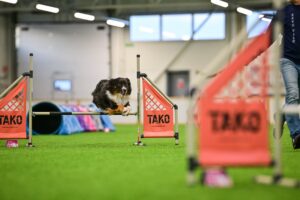
The relationship between owner and dog is important; without contact it is not possible to practise agility. Some prior knowledge is needed — coming when called and staying in place are the most important of these. Agility is built on a trusting and good relationship between owner and dog, not on compulsion!
Agility is an excellent way to channel your dog’s energy and thinking ability, and through that to strengthen your relationship with your dog!
Dogs compete in three groups:
MINI – dogs with a height at the withers of up to 34.99 cm
MIDI – dogs with a height at the withers of 35 to 42.99 cm
MAXI – dogs with a height at the withers over 43 cm
At competitions there are three official classes, A1, A2 and A3, of which A3 is the highest and the only international competition class. Competitions often also include an unofficial class, A0, which is the easiest class and intended for beginners.
Agility on Wikipedia: https://et.wikipedia.org/wiki/Agility
EKL agility regulations: https://kennelliit.ee/et/ekl-kkk-dokumendid-ja-blanketid/
Current information on Estonian agility competitions: http://agilitykoer.ee/?controller=competitions
Obedience training
Obedience training (KK) is a discipline originally created for training service dogs. All dogs may attend KK training and competitions. Many people simply want an obedient friend and do not wish to compete. The aim of obedience training is to give dogs a basic education in obedience and to teach dog owners correct and sensible communication with their dog.
Obedience training is a national discipline developed by Estonia’s leading service dog trainers. Those who wish can compete and attend examinations. At examinations and competitions the result of what has been learned is assessed. In performing the exercises, correctness, compliance and controllability are judged. At the same time the dog’s energy and joy in the work done also matter.
Competition is at three levels, KK-1, KK-2 and KK-3. Estonian championships are also held in obedience training; at that level mistakes are no longer seen, and speed and precision in carrying out the commands are decisive. The championships are held only for dogs of the highest class, KK-3.
At all KK levels the dog must lie in place and walk at heel, and while performing both exercises a couple of shots are fired from a starting pistol (from KK-2 onwards). The dog must not be afraid of the shots. In addition the dog must perform a recall, sit, lie down and/or stand from movement, retrieve an object (including over a jump), and also be sent to a place.
Obedience training is a discipline from which it is easy to move on later to other sports intended for service dogs, such as tracking and IGP (IPO).
EKL obedience training regulation: https://kennelliit.ee/et/ekl-kkk-dokumendid-ja-blanketid/
Obedience (SK)
The aim of obedience training, or SK for short, is to teach the dog pleasant behaviour and obedience, and at the same time to teach the dog owner correct and sensible communication with the dog. In SK training particular attention is paid to the contact between handler and dog, and to the dog’s willingness to obey commands even when off lead and at a distance from the handler.
The aim of SK competitions is to check the result of the training, that is the cooperation between dog and handler, and also the standard of the behaviour taught to the dog. A further aim is to create a dog hobby with an animal-friendly and healthy competitive atmosphere.
Obedience is an international training discipline in which four levels of difficulty are distinguished at competitions, namely the beginners’ class, SK1, SK2 and SK3, the international class.
To compete in the easiest class, the beginners’ class, the dog must be able to walk at heel, lie down, sit, stand, come when called, stay in place and clear a jump at the height of its withers.
In the higher classes more difficult elements are added, for example sending the dog from a distance into a square marked with cones, identifying an object carrying the handler’s scent, retrieving both without clearing an obstacle and with a jump over an obstacle, distance control (i.e. changes of position at a distance), a recall with stand and down halts, stopping in a stand and a sit from movement, and so on.
Dogs without pedigrees may take part on equal terms with dogs holding a pedigree certificate, except at the Estonian championships and international competitions.
EKL obedience regulations and other documents concerning SK: https://kennelliit.ee/et/tegevus/vaba-aeg/sonakuulelikkuse/
Rally obedience
Rally obedience (RK) is a dog sport in which communication and cooperation between dog and handler are to the fore. In rally obedience the main emphasis is not on precision but on teamwork!
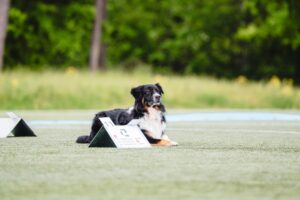
This is a delightful dog sport based on the basic elements of obedience training (sit, stand, down, heel work and so on), in which the dog together with the handler completes a course made up of command signs and performs various enjoyable exercises.
Rally obedience is based on joy, communication and cooperation. Rally obedience gives mental work to both owner and dog, and since the courses change, it never becomes boring! This sport suits all dogs and their owners who have a good relationship and contact, which regular practice will certainly further encourage. The rally obedience regulation and other documents: https://kennelliit.ee/et/ekl-kkk-dokumendid-ja-blanketid/
Water rescue
Water rescue – a discipline originally intended for Newfoundlands and Landseers, the aim of which was to preserve the rescue instinct and swimming ability characteristic of those breeds. In the tests the dog’s ability to carry out tasks in water and its physical stamina are measured; for example the dog must perform several elements — jumping from a boat into the water, towing the boat to shore, fetching an object and so on. Today dogs of various breeds and mixed breeds also take part in water rescue training and tests – the only limits are set by the dog’s physical abilities. To practise this discipline the dog should love swimming and should be big and strong enough to tow a person in need of help, or a boat, to shore – including in strong wind or waves.
The discipline is practical in any case, since at some point a dog’s skill may save a human life.
Water rescue is run in northern Estonia by – the Estonian Newfoundland and Landseer Breed Club.
In southern Estonia – the southern Estonian water rescue group Märjad Käpad.
Water rescue test regulation: https://kennelliit.ee/wp-content/uploads/2019/06/VPeeskiri_2019.pdf
Estonian Newfoundland and Landseer Breed Club http://www.vesikoer.ee/
Southern Estonian water rescue group Märjad Käpad https://www.facebook.com/L%C3%B5una-Eesti-veep%C3%A4%C3%A4stekoerte-grupp-M%C3%A4rjad-k%C3%A4pad-1565358203776931/
Rescue Association https://paasteliit.ee/eripaaste/
Rescue training
This is a discipline that is very interesting to teach and that gives the dog very useful skills and at the same time a good workload. Competitions in this discipline are held in Estonia, but it is also possible to go and try competitions in other countries. Rescue work can be taught in two environments: in the forest or in rubble. In both cases the dog must find the missing person and inform the handler of it. This is again a very practical discipline, since people go missing in forests all the time and finding them with the help of dogs is one of the simplest options.
The training of rescue dogs is run by the Estonian Search Dog Club; more information on their website www.otsingukoerad.ee
International rescue dog examination regulation: https://kennelliit.ee/wp-content/uploads/2018/10/IPO-R-2019-eeskiri-EE.pdf
Assistance and therapy dogs
A therapy dog is a dog that has completed special training and is able to establish and offer contact to people who need it, thereby easing tension and creating a link with the surrounding world.
Estonian Assistance and Therapy Dog Association http://teraapiakoer.ee/
Therapy dog: https://et.wikipedia.org/wiki/Teraapiakoer
DOG SCHOOLS
| Dog club | Phone | Website |
|---|---|---|
| Agilityklubi „Agility Pluss“ | 5669 9025 | agilityplus.blogspot.com.ee |
| Agilityklubi „A-Koer“ | 5624 8401 | www.akoer.eu |
| Eesti Koeraspordiliit | 517 2266 | www.koerasport.ee |
| Eesti Otsingukoerte Klubi | 5667 7605 | www.otsingukoerad.ee |
| Eesti Päästekoerte Ühing | 515 2628 | www.paastekoerad.ee |
| Eesti Tõukoerte Kelguspordi Klubi | 501 6814 | |
| Koeraspordiklubi „Koerus“ | 506 3593 | www.koerus.ee |
| Koeraspordiklubi Topdog | 5660 0075 | www.topdog.ee |
| Koerte Dressuurikool „Canis“ | 511 2645 | www.canis.ee |
| Koerteklubi „Aktiiv“ | 5622 2357 | www.koerteklubiaktiiv.eu |
| Koerteklubi „Säde“ | 5047 699 | FB Koerteklubi Säde |
| Pärnu Agility | 514 7821 | www.parnuagility.net |
| Pärnumaa Koeraspordi Klubi „Minu Sõber“ | www.lemmikloom.eu | |
| Saarlaste Agilityklubi | 5341 3653 | www.saarlasteagility.ee |
| Sportkoer | 5621 0208 | www.sportkoer.ee |
| Tarkade Koerte Klubi | takoklubi.blogspot.com | |
| Teenistus- ja Spordikoerte Klubi | 502 9661 | www.tskk.ee |
| ViLe | 53 499815 | www.vileklubi.eu |
| Viimsi Koer | 515 2358 | www.viimsikoerteklubi.ee |